The debris of a jet engine from Malaysia Airlines flight MH17 is seen near the settlement of Grabovo in the Donetsk. (IMAGE: REUTERS/MAXIM ZMEYEV)
It was not only an airliner that was shut down in Ukraine, but the last vestige of the post-Cold War global order, and the popular myth regarding the containability of “local” conflicts. In today’s hyper-connected world, conflict anywhere is a conflict everywhere, for spillovers are unavoidable and containability a myth.
It is not that there are more tragedies happening around us today than there were during the height of the Cold War, in fact, there are arguably less tragedies today than there were then. It’s our awareness of what’s happening around us that has changed. Through social media, satellite technology and around-the-clock news coverage, we have been deprived of the ability to ignore the world and feign ignorance.
A Syrian man carries a girl on a street covered with dust following a government airstrike in Aleppo on Tuesday. Rebels took the eastern half of the city in 2012 but are now in danger of being forced out by President Bashar Assad’s troops. (Baraa Al-Halabi/AFP/Getty Images)
The reduction of our choices in Syria to a lesser of all evils was something that was orchestrated by the Assad regime and its allies from the early days of the Syrian Revolution back in 2011. Indeed, our road to this particular hell was paved with all the ill-intentions and foresight in the world by people who have done this repeatedly before, and made quite the survival strategy out of it. Still, it does take a strong element of willful blindness on part of so many who are clearly in a position to know better to let something like this happen, again and again. Considering the repetitive patterns involved, one cannot but assume ill-intentions here as well. In other words, and for all the talk about good intentions paving our way to hell, in reality, we more often get there on account of ill-intentions and evil designs.
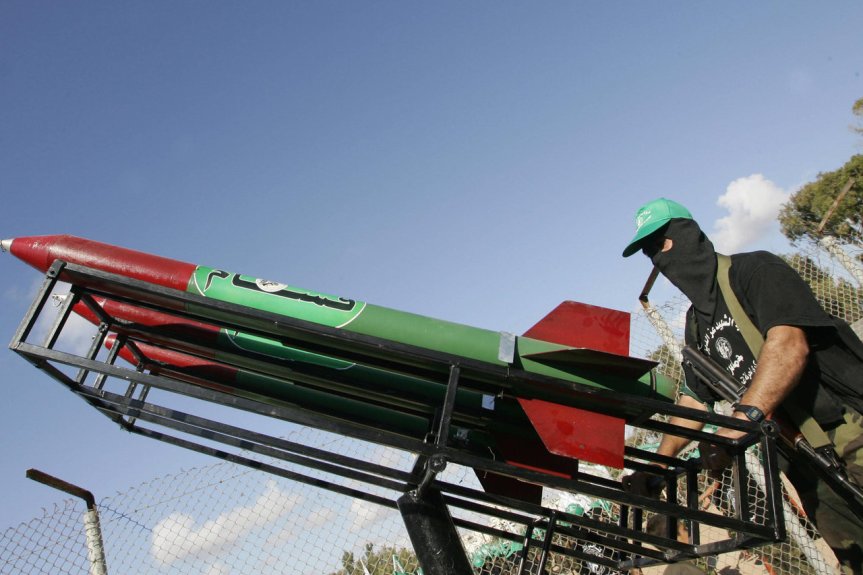
GAZA CITY: A Palestinian militant from the Ezzedine al-Qassam Brigades, the military wing of the Islamic Resistance Movement Hamas, displays Qassam rockets during a rally in Gaza City 18 September 2005. (ABED/AFP/Getty Images)
The hard truth is: yes. Just like the Assad regime in Syria, and Arab leaders in general, the calculus of Hamas leaders when it comes to the conduct of war and peace is rather different than what we are publicly told. Their ultimate mandate is not to protect their civilian population and build the state, but to protect their rule and increase their power, even at the cost of incurring heavy civilian casualties and destroying the state. If they can still retain control at the end, that’s victory enough for them.




 The Ammar Abdulhamid Archive